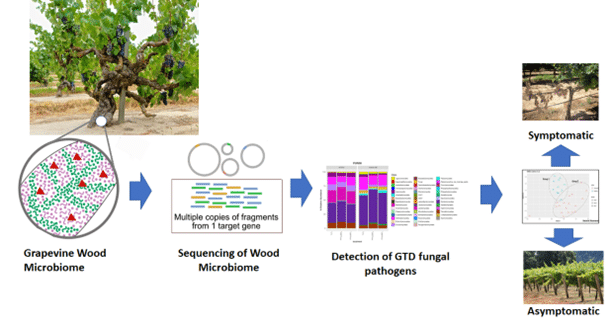
Plant-associated microorganisms exhibit diverse lifestyles, ranging from pathogenic to mutualistic and commensal interactions. Recent advances in microbiome research have revealed the remarkable diversity of microbial communities inhabiting plant tissues and surrounding environments, including epiphytic, endophytic, and rhizosphere-associated microorganisms. Together with their host, these microbial communities form the plant holobiont, a dynamic and integrated biological system that plays a crucial role in plant growth, health, development, stress adaptation, and ecosystem functioning.
We study the factors that shape plant microbiome composition, assembly, and function across a range of agriculturally important crops, including olives, grapevines, and other cultivated species, as well as native plants and forest trees. Using multi-omics approaches such as metataxonomics, metagenomics, and metatranscriptomics, we investigate microbial diversity, succession, and functional dynamics in both natural and managed ecosystems. Our research explores the links between microbiome composition, plant health, and disease, aiming to identify microbial and pathogen signatures associated with healthy and diseased plants and to develop predictive frameworks for microbiome-based plant health assessment. In grapevine systems, we study microbial succession and functional dynamics during post-harvest processes, including grape fermentation, towards a microbiome-mediated identification of the key microbial players in the establishment of vine aromas. We also examine how the application of beneficial microbial inoculants influences indigenous microbial communities, microbiome assembly, and plant performance.