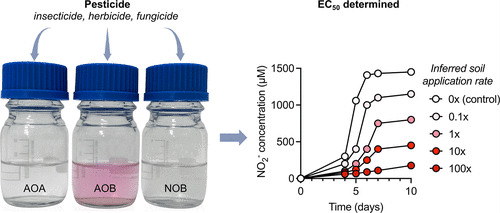
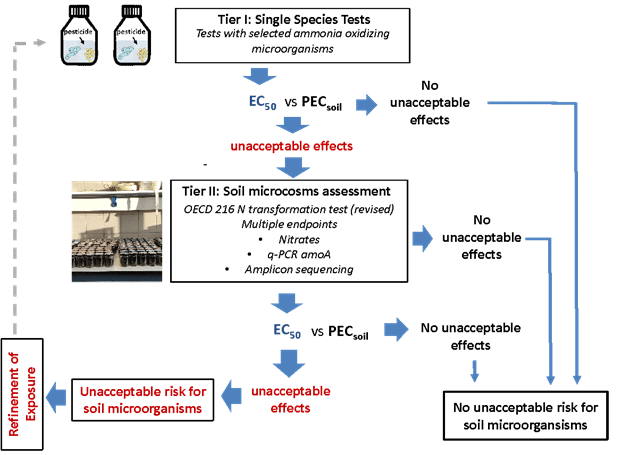
Toxicity of pesticides onto non target organisms is an indispensable part of the pesticide regulatory framework. Although advanced protocols and tools have been developed and used for the assessment of the toxicity of pesticides on aquatic organisms and terrestrial macro-organisms this is not the case for soil microorganisms. Despite their pivotal role in soil ecosystem functioning, the assessment of the toxicity of pesticides on soil microorganisms is still lagging behind, relying on the N transformation (OECD 216). We intensively work in this area with main goal to develop advanced risk assessment schemes that could assess the potential ecotoxicity of pesticides on the soil microbiota. We work on tools development and standardization, identification of microbial bioindicators that could be used as proxies for assessing the toxicity of pesticides on the whole soil microbiota, and have proposed a tiered risk assessment approach. This is based on the use of ammonia oxidizing microorganisms and arbuscular mycorrhizal fungi as key microbial bioindicators which could be tested for their responses to pesticides at assays with different experimental complexity. We have developed and validated single species tests for ammonia oxidizers and arbuscular mycorrhizal fungi and further proposed soil microcosm studies based on an revised OECD 216 test that will encompass multiple molecular endpoints. We have further pioneered the use of Species Sensitivity Distributions in the ecotoxicity assessment using data from single species tests and soil amplicon sequencing that provide valuable ecotoxicological thresholds enabling quantitative risk assessment.
Gkimprixi, E., Lagos, S., Nikolaou, C. N., Karpouzas, D. G., & Tsikou, D. (2023). Veterinary drug albendazole inhibits root colonization and symbiotic function of the arbuscular mycorrhizal fungus Rhizophagus irregularis. FEMS Microbiology Ecology, 99(6), fiad048. https://doi.org/10.1093/femsec/fiad048
Papadopoulou, E. S., Karas, P. A., Nikolaki, S., Storck, V., Ferrari, F., Trevisan, M., Tsiamis, G., Martin-Laurent, F., & Karpouzas, D. G. (2016). Dissipation and adsorption of isoproturon, tebuconazole, chlorpyrifos and their main transformation products under laboratory and field conditions. Science of The Total Environment, 569–570, 86–96. https://doi.org/10.1016/j.scitotenv.2016.06.133

Key figures that reflect the laboratory’s activity, scientific output and contribution to research and education.