
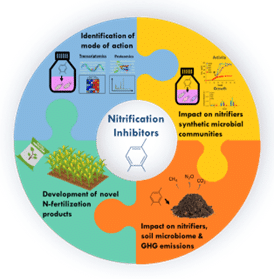
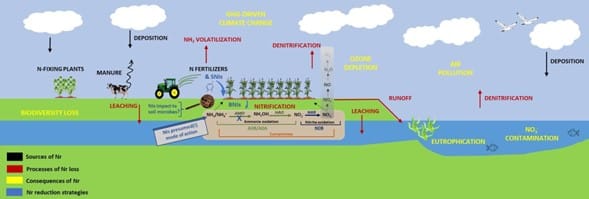
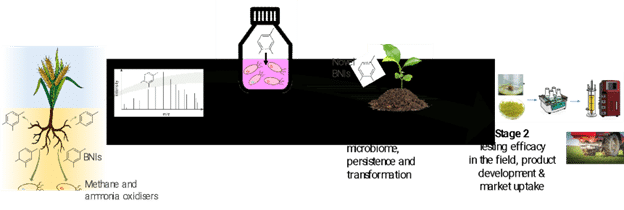
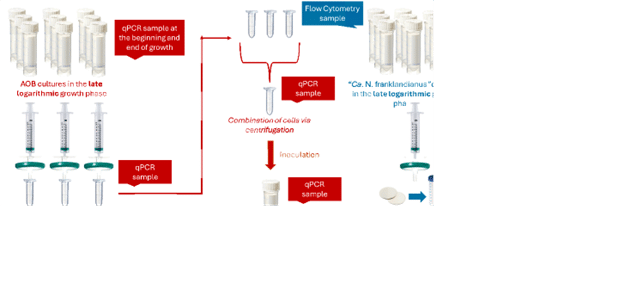
Nitrification is the rate-limiting step of N cycling. It is performed in two successive steps by ammonia oxidizing bacteria (ΑΟΒ) or archaea (ΑΟΑ), and nitrite-oxidizing bacteria (ΝΟΒ). In 2015 bacteria of the genus Nitrospira sp. (formerly known as ΝΟΒ) were found to be able to perform the complete oxidation of ammonia to nitrate, and they were named Comammox (Complete-ammonia-oxidation). The increasing application N fertilizers have boosted nitrification rates leading to enhanced N2O emissions and production of NO3 that either fuel denitrification and further greenhouse gas emissions in the form of N2O or lead to NO3 leaching to groundwater. The use of Synthetic Nitrification inhibitors (SNI) is the current golden standard for decelerating nitrification, increasing nitrogen use efficiency and reducing emissions of reactive nitrogen in the environment. However, SNIs are characterized by erratic performance, selective inhibition of ammonia-oxidizing bacteria and have been associated with risk for human and environmental health. In this frame, our group pioneers research on the development of novel solutions like biological nitrification inhibitors, secondary metabolites exuded by plant roots and regulate the activity of soil nitrifiers. We have developed pioneering platforms, based on our rich collection of nitrifiers, for the high-throughput assessment of the inhibitory activity of plant extracts and individual compounds. In this frame we collaborate with University Claude Bernard Lyon 1 (G. Nicol & Christina Hazard), University of Vienna (C. Schleper, W. Weckwerth) and University of Alberta (Lisa Stein) in our quest to provide novel biotechnological solutions to combat greenhouse gas emissions from agriculture.
Ghatak, A., Kanellopoulos, A. E., López‐Hidalgo, C., Malits, A., Meng, Y., Schindler, F., Zhang, S., Li, J., Waldherr, S., Ribeiro, H., Kerou, M., Hodgskiss, L. H., Dreer, M., Mir, R. R., Sharma, S., Bachmann, G., Karpouzas, D. G., Schleper, C., Papadopoulou, E. S., … Weckwerth, W. (2025). Natural variation of the wheat root exudate metabolome and its influence on biological nitrification inhibition activity. Plant Biotechnology Journal, 23(11), 4755–4772. https://Ghatak, A., Kanellopoulos, A. E., López‐Hidalgo, C., Malits, A., Meng, Y., Schindler, F., Zhang, S., Li, J., Waldherr, S., Ribeiro, H., Kerou, M., Hodgskiss, L. H., Dreer, M., Mir, R. R., Sharma, S., Bachmann, G., Karpouzas, D. G., Schleper, C., Papadopoulou, E. S., … Weckwerth, W. (2025). Natural variation of the wheat root exudate metabolome and its influence on biological nitrification inhibition activity. Plant Biotechnology Journal, 23(11), 4755–4772. https://doi.org/10.1111/pbi.70248

Key figures that reflect the laboratory’s activity, scientific output and contribution to research and education.


